



Published on
April 12, 2026
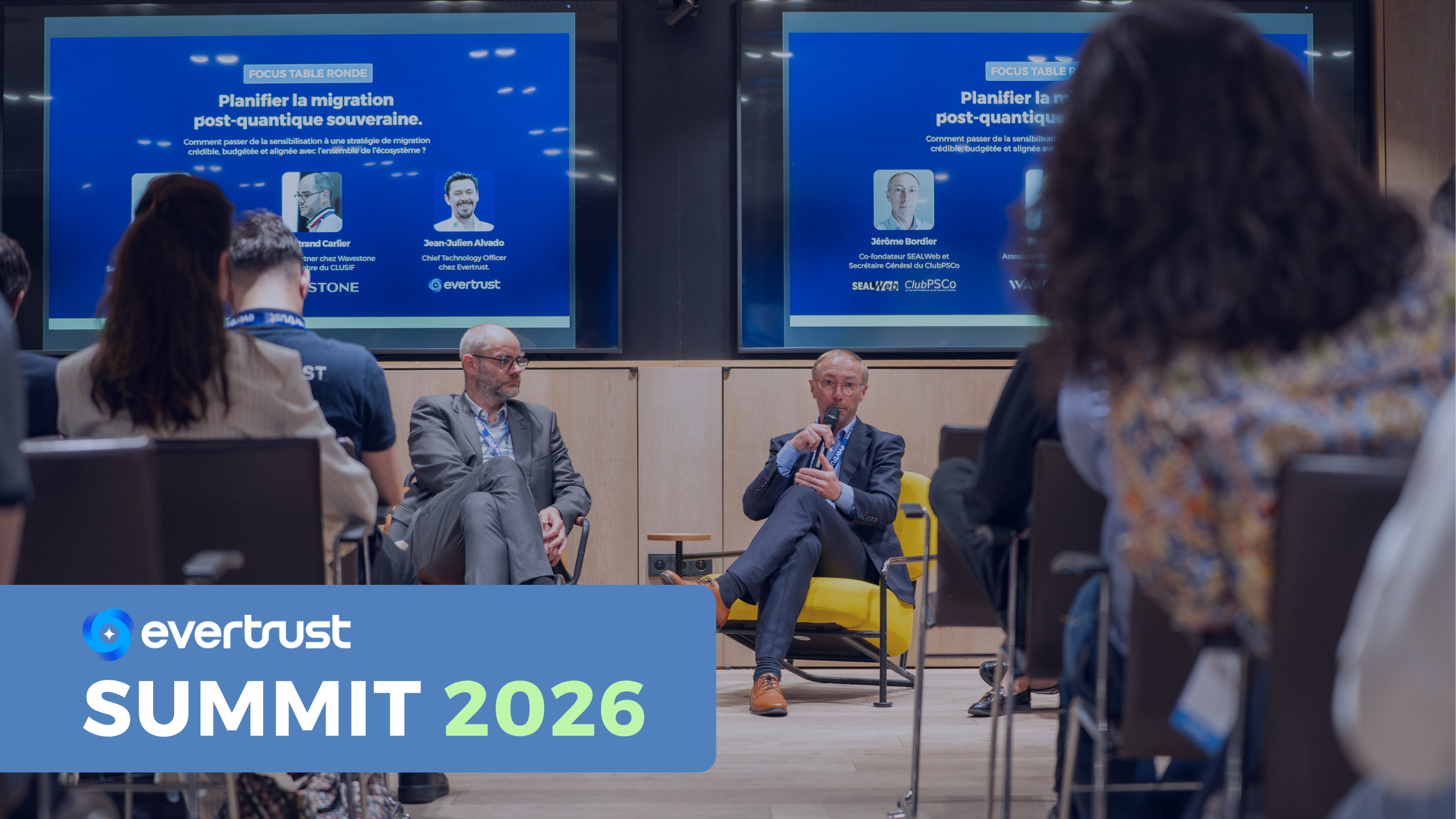
On April 9, Evertrust brought together clients and decision-makers from the digital trust market in Paris for a new edition of the Evertrust Summit. Designed as a deliberately selective event, the Summit gathered around 80 to 90 participants around a topic that can no longer be treated as a simple matter of monitoring trends: the post-quantum transition.
As the evening unfolded, one conviction became clear: post-quantum is no longer just a question of algorithms or technological maturity. It is becoming a matter of program management, governance, budget, coordination, and operational readiness. That shift in perspective is precisely what shaped the tone of this 2026 edition.
To open the event, Evertrust shared its view of the transformations currently reshaping digital trust, along with the latest developments across its CLM and PKI platforms. Through Horizon, its certificate lifecycle management and cryptographic asset governance platform, and Stream, its PKI platform for managing certification authorities, Evertrust supports organizations on issues that have now become critical: certificate visibility, automation, multi-PKI governance, compliance, and operational resilience.
The highlight of the evening was a roundtable discussion entitled:
“How can organizations move from awareness to a credible, budgeted migration strategy aligned with the broader ecosystem?”
Moderated in a 45-minute format, the panel brought together three complementary perspectives on the post-quantum transition: Jérôme Bordier, Managing Director at SEALWeb and Secretary General of ClubPSCo; Bertrand Carlier, Associate Partner at Wavestone; and Jean-Julien Alvado, Co-founder and CTO of Evertrust.
The discussion first confirmed a clear shift in the market. In 2025, the conversation was still largely focused on raising awareness of post-quantum risks and outlining the broad steps to consider. One year later, many organizations have started to move forward: some are launching their first cryptographic inventories, while others are beginning to structure their thinking around architecture, governance, and program steering. In other words, the subject is changing in nature: it is moving out of the theoretical realm and into execution.
Bertrand Carlier emphasized how this shift now requires organizations to treat PQC as a company-wide transformation initiative. The first questions emerging are no longer purely technical: how do you secure executive sponsorship, justify a budget, identify priorities, build a realistic five-year roadmap, and determine which resources need to be mobilized in the first year? Post-quantum is therefore becoming a structured transformation topic, with its own dependencies, trade-offs, and constraints.
For his part, Jérôme Bordier stressed a key point: post-quantum migration cannot be addressed in silos. A trust infrastructure may be ready, a PKI may be compatible, certificates may be issued — but that is not enough if applications, devices, validation chains, and third-party services are still unable to consume them properly. In other words, the challenge is not only about introducing new certificates, but about making everything else work with them. This is why collective initiatives, such as the one led by ClubPSCo, large-scale testing, and the production of shared feedback and lessons learned are becoming critical levers for the market as a whole.
Jean-Julien Alvado brought the discussion back to operational reality. His message was straightforward: you cannot migrate what you cannot see. Before any credible strategy can be put in place, organizations need to be able to map their certificates, algorithms, application dependencies, and potential points of friction. From this perspective, continuous inventory, CLM, automation, realistic test environments, and crypto-agility become essential building blocks for serious preparation. The tools are there, but the challenge is no longer simply to know whether they support new standards — it is now about determining how to evolve the infrastructure without disrupting production.
Another key takeaway from the evening was the issue of sovereignty. The discussion highlighted that preparing for post-quantum is not limited to adopting standards. It also involves the ability of European players to test together, develop their own reference frameworks, document their own feedback, and collectively influence the direction of the market. In that respect, the work carried out within ClubPSCo was identified as a particularly structuring force for advancing the ecosystem as a whole.
Beyond the content itself, this 2026 edition confirmed what makes the Summit distinctive: a format designed to foster direct discussion, in-depth exchange, and unfiltered feedback.
We warmly thank all the participants, speakers, and partners who joined us in Paris for the quality of their discussions, questions, and insights. These conversations help shape our thinking, strengthen our roadmap, and support us in building ever more useful solutions to address the very real challenges of digital trust.