







GRC and compliance teams
Accountable for evidence you can't produce today. You get handed technical exports and asked for a report by Friday.
Audit prep in minutes, not weeks. Export a live posture report instead of rebuilding evidence from scratch.
Cryptographic Posture Management — discover, grade & remediate your whole cryptographic estate

Sovereign Certificate Authority for enterprise-grade certificate issuance & management

Certificate Lifecycle Management, discovery, governance & automation
DNS-agnostic Domain Control Validation, ready for 47-day TLS certificates
French Tech 2030 laureate Made in France
Evertrust Cryptographic Posture Management
Prove it, on demand.
Turn cryptographic data into decisions, proof and a governed plan to meet regulatory compliance and prepare for post-quantum migration.
Built by the team already running digital certificate lifecycle for 50+ regulated enterprises across Europe.
Evertrust CPM turns every finding into proof, checked against your policies, sent for remediation through your tools, and exportable in a click.
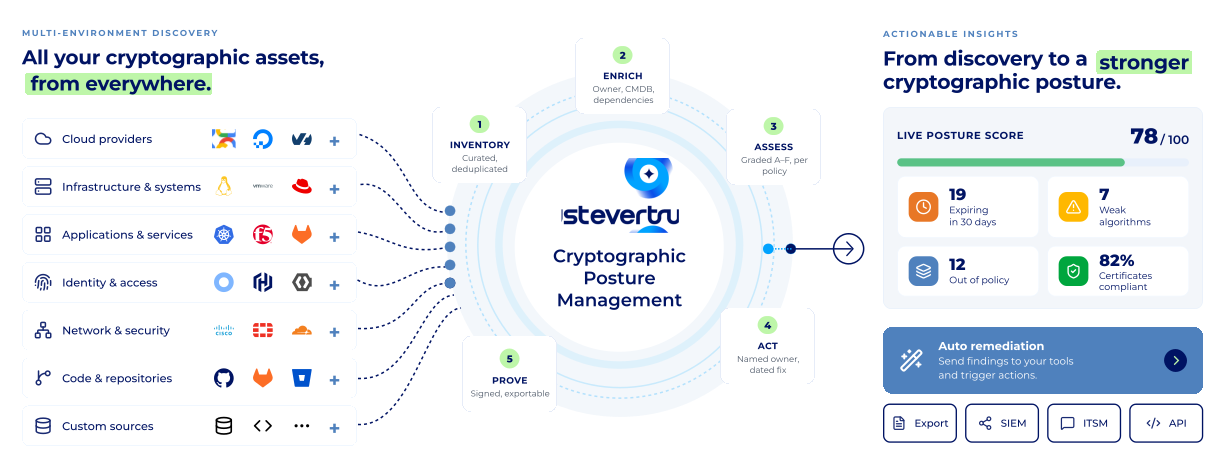
Cryptographic posture management applies security-posture discipline to cryptography: know every certificate and key you run, grade each one against policy, fix what's weak and prove compliance on demand.
Most teams can already produce a list of certificates and keys. Grading that list against NIS2, DORA or PCI-DSS, and proving it on demand, is still a manual, ad-hoc job repeated every audit cycle. Evertrust CPM turns that list into a governed, continuously graded record, with every fix verified and every export signed.
What teams get from Evertrust CPM
Accountable for evidence you can't produce today. You get handed technical exports and asked for a report by Friday.
Audit prep in minutes, not weeks. Export a live posture report instead of rebuilding evidence from scratch.
Two clocks are running: regulatory and quantum. The board wants numbers and a fine is the alternative.
One posture score with a trajectory when the board asks how exposed you really are.
Keys and certificates sit across CAs, HSMs, clouds and code, and nobody holds the full map.
See every dependency, from key to application, before you rotate, renew or swap an algorithm.
Blamed for everything, owning nothing formally. Every crypto finding lands on your desk, whoever's system it is.
Findings arrive already attributed to an owning team, with the fix wired to your ticketing and automation.
Not sure where you stand?
Get the CPM datasheet: architecture, connectors, frameworks covered, deployment options.
How it works
Discover, Remediate. Prove.
Five steps close the loop inside one product.
Each one answers a question an auditor will ask.
“What do you actually have?”
Step 1
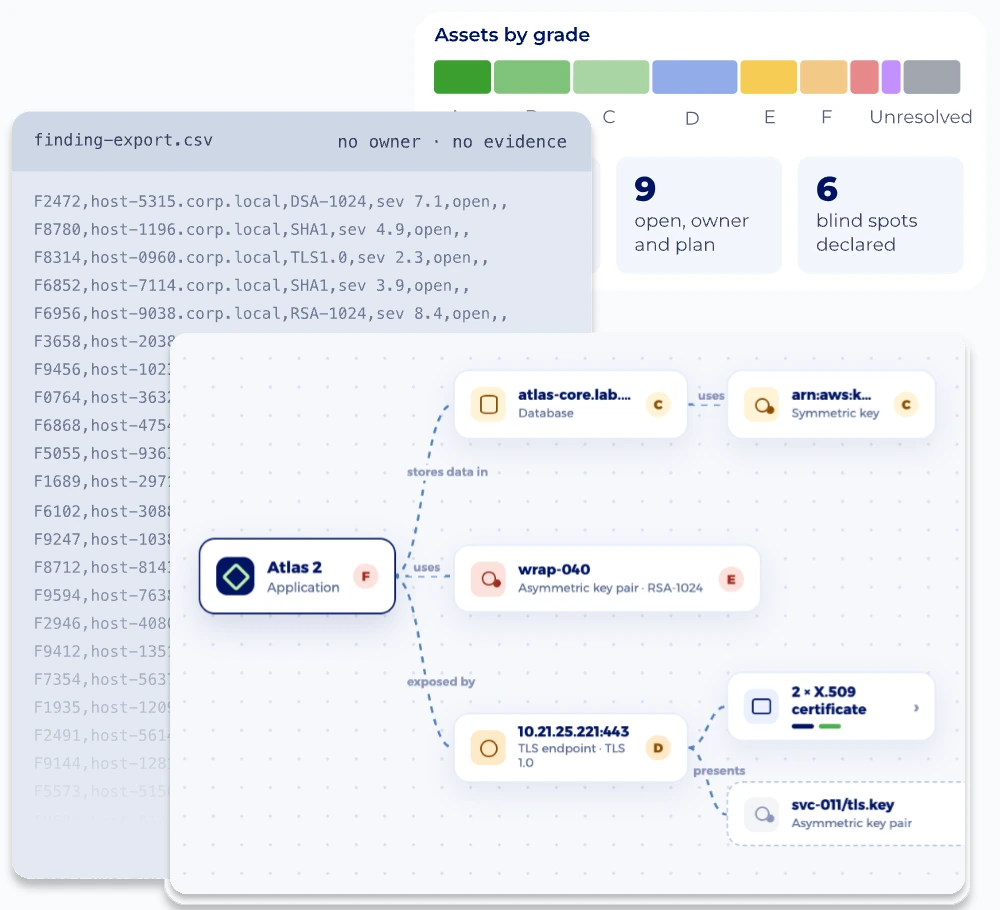
Evertrust CPM builds one curated cryptographic inventory with enrichment actions and metadata from the systems you already use : CMDB, KMS and vaults, code repositories, Kubernetes, certificate lifecycle manager as well as CBOM/SBOM files.
Map every asset to everything that depends on it : apps, tokens, TLS endpoints, libraries, databases, vaults, right down to the HSM.
“Which rulebook graded it, and which version?”
Step 2
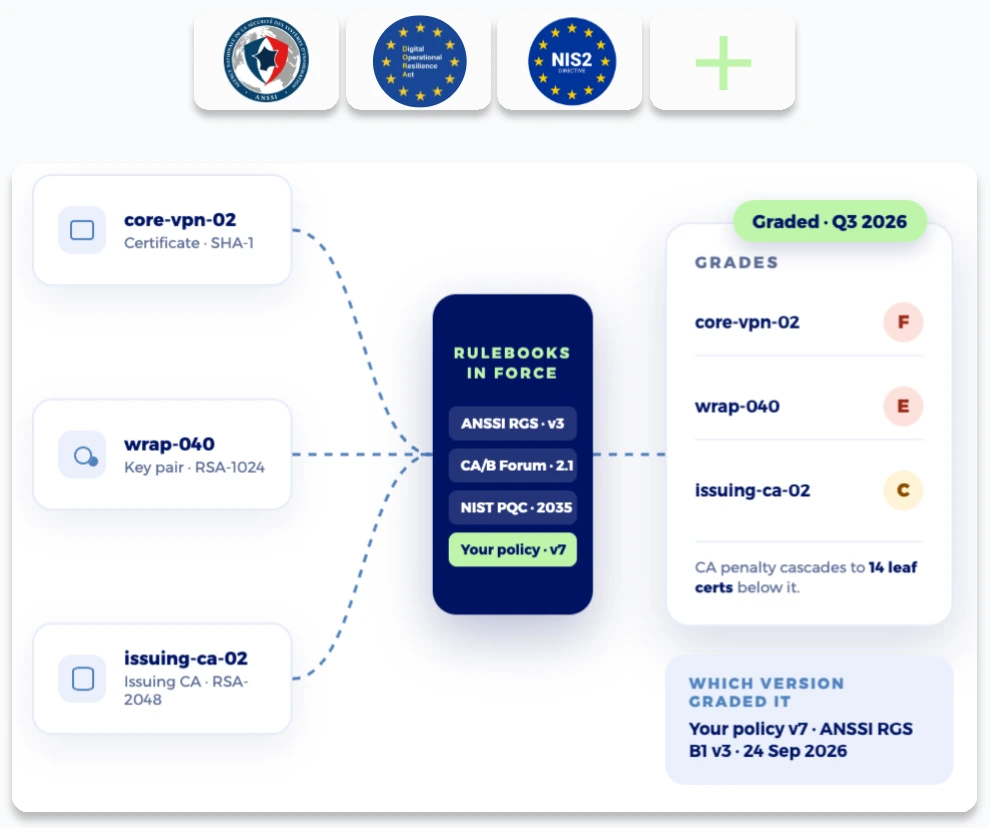
Every asset is assessed continuously against preloaded references (ANSSI RGS, CA/Browser Forum, NIST transitions, a PQC target) and your own policies. Every policy is versioned, so you can show which rules graded which quarter.
Knows what to look for
Expiring and revoked certificates, keys hardcoded in repos, weak suites, end-of-life libraries, unrotated legacy keys, shadow assets, and CA weaknesses whose PQC penalty cascades down the tree.
“Who owns it, and what did you do about it?”
Step 3
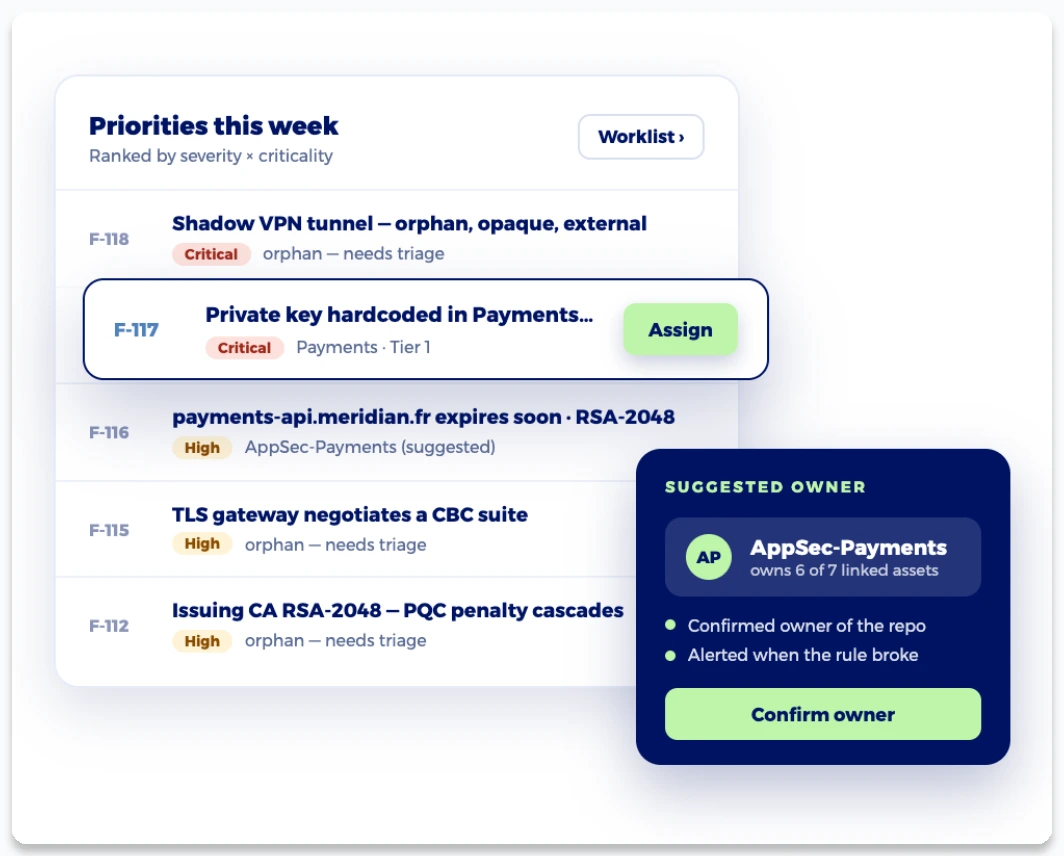
Evertrust CPM spots the classic weaknesses (expiring certificates, hardcoded keys, weak suites, end-of-life libraries, unrotated legacy keys, shadow assets), ranks them by severity and the business criticality you set, suggests the owner, and alerts them the moment a rule breaks.
“How do I know it was really fixed?”
Step 4
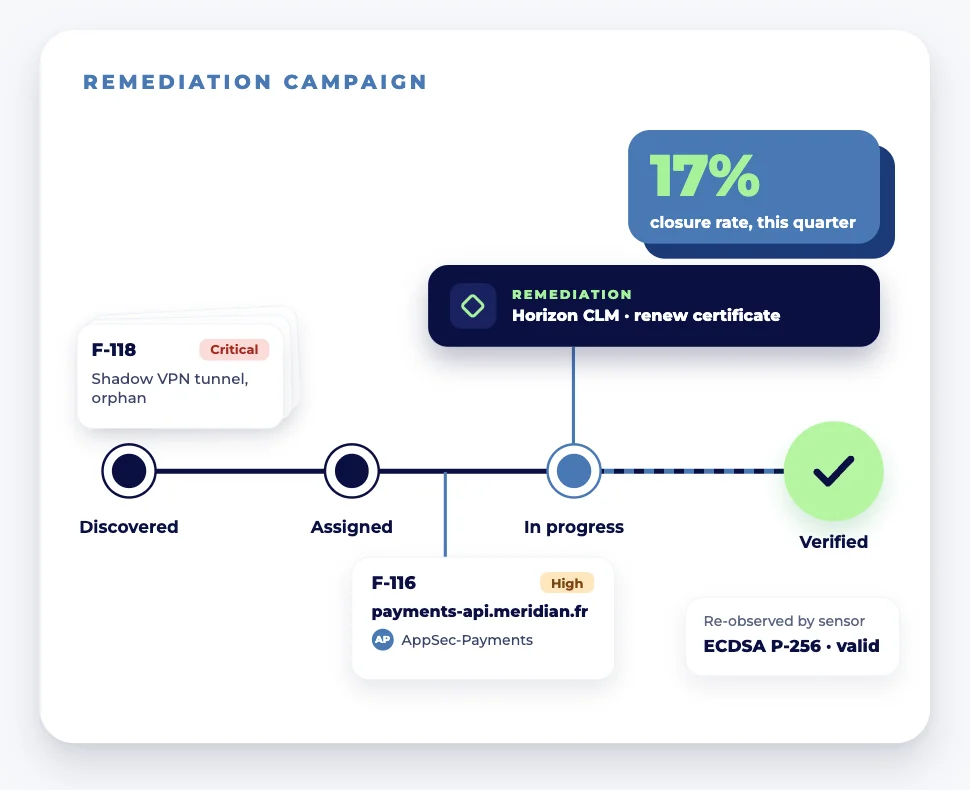
Evertrust CPM opens the ticket in your ITSM tool, triggers your own automation, or asks your certificate lifecycle manager to renew, then closes the fix only after a connector looks again and confirms it. Every step is dated, so even unfinished remediation is defensible, and the quarterly fix rate is a figure you can trust.
“What don’t you know yet?”
Always on
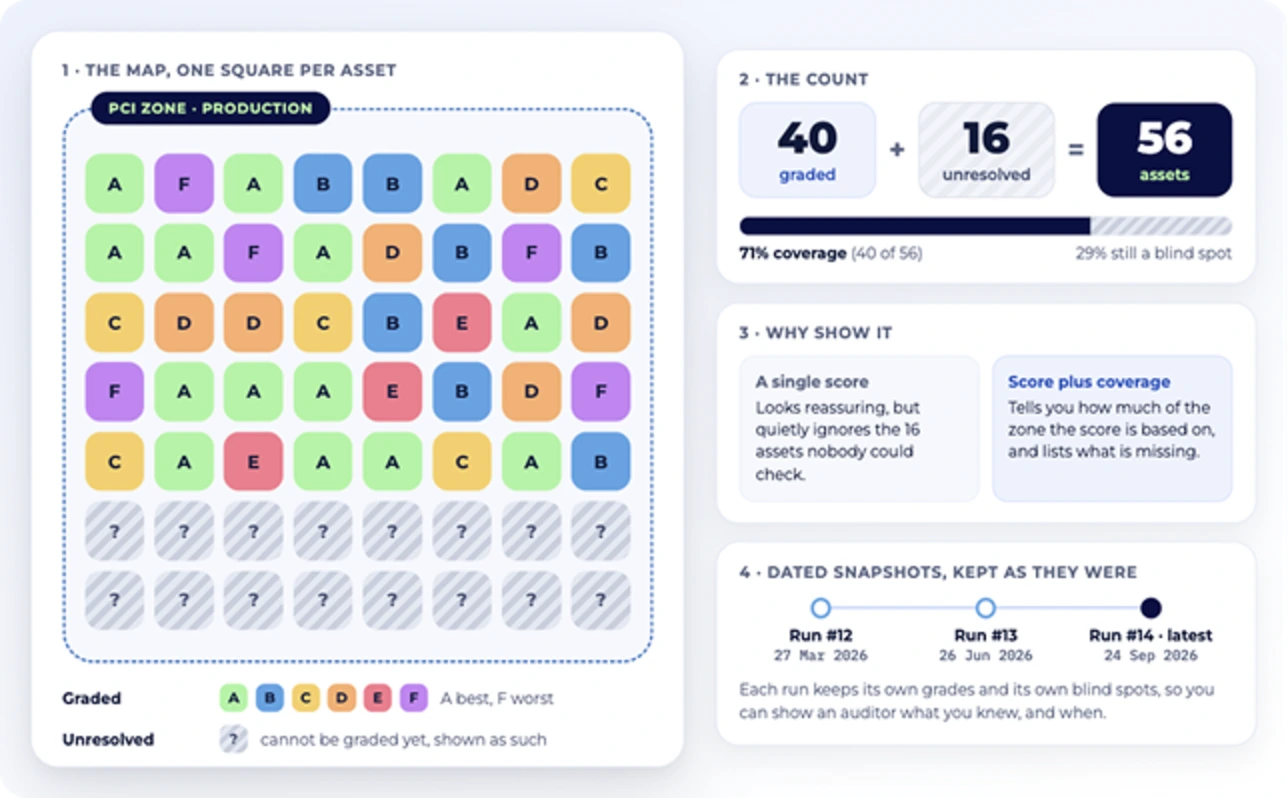
Select the perimeter (your PCI zone inside production, the Paris datacenter) and coverage is measured against it. What can't be assessed yet stays in the numbers as Unresolved, and each campaign run archives a dated snapshot, so you can show what you knew, and when.
“Can you show me, for this scope and this period?”
Step 5
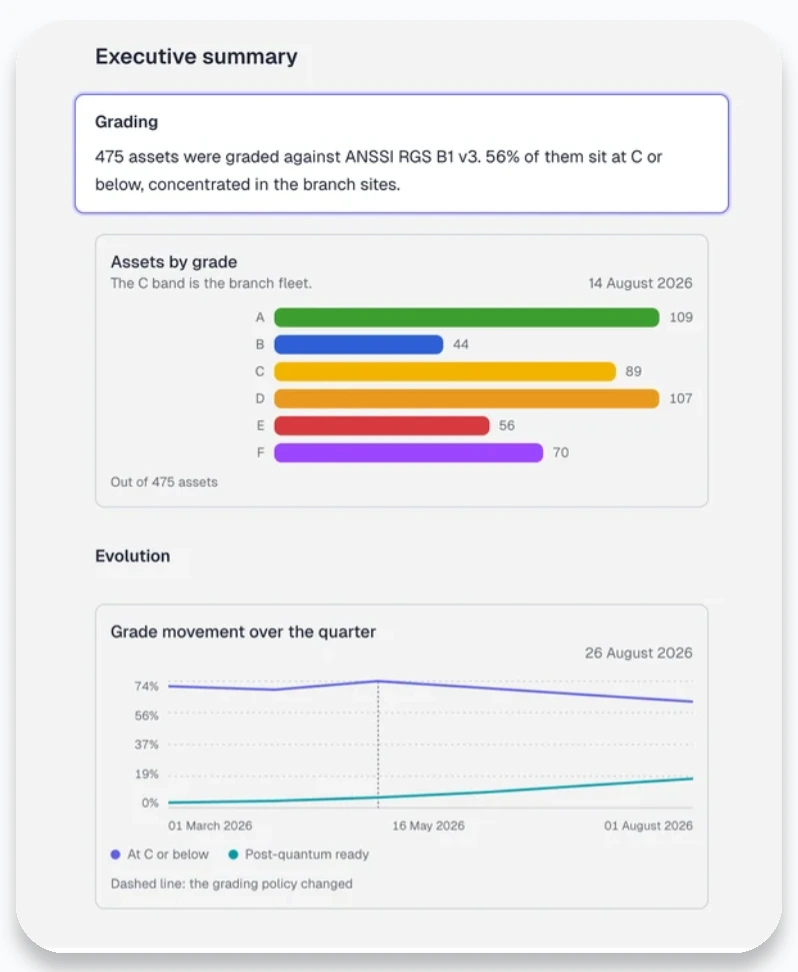
Everything above exists to make this moment possible: pick the scope, the rulebook, the period and the chapters, and the pack is built from live data. Each one is signed, archived with its date and operator, and shows progress quarter by quarter, in French or English, under your logo.
Works with your GRC
Nothing to rip out. Your GRC platform keeps the compliance workflow, and CPM becomes the measured source of truth for its cryptography controls, instead of a checkbox and a screenshot.
Talk to an expert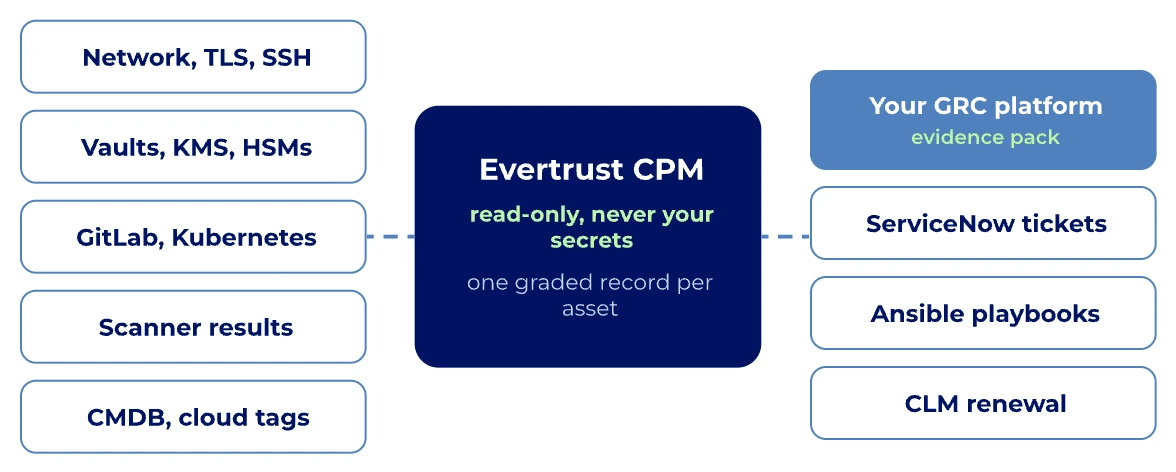
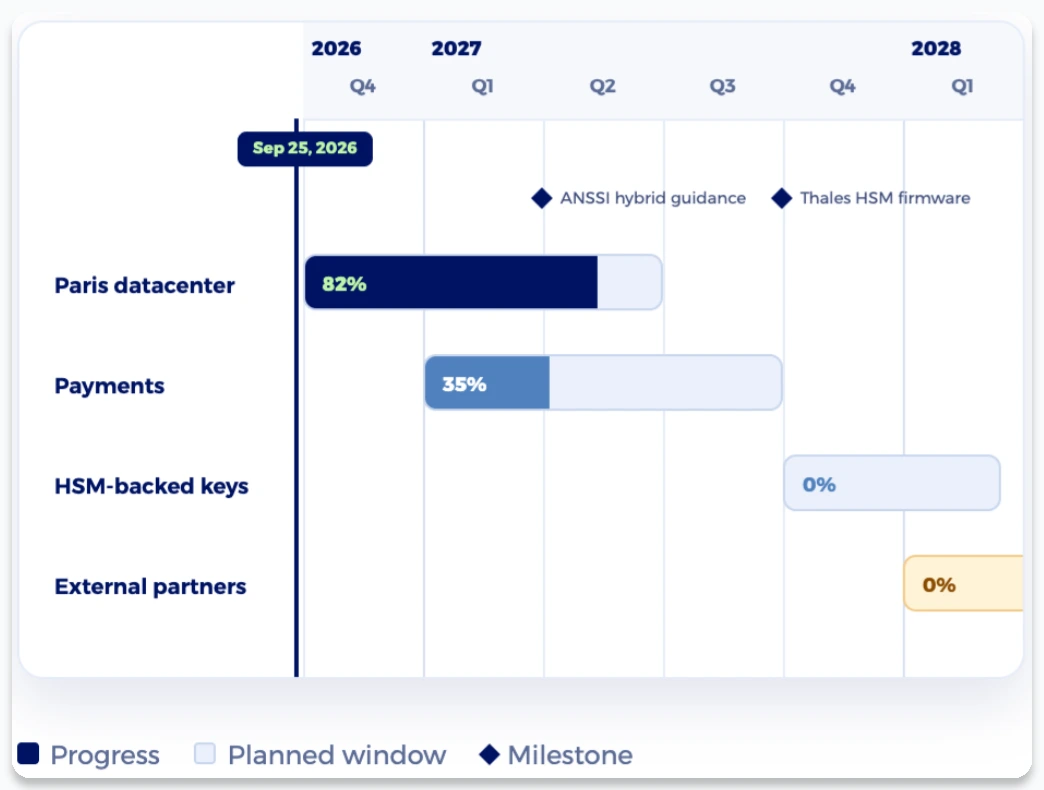
You can't migrate what you can't govern. The dependencies, owners and plan you already have become the migration plan. CPM governs and plans it; it does not rewrite your applications.
Gartner puts a cryptographically relevant quantum computer at about 75% likelihood around 2030.
Source : Gartner Insights, Postquantum Cryptography: Why You Need to Be Ready by 2030
Readiness state the board can hear
"25% of our systems are quantum-safe or on a dated plan", tracked quarter by quarter, with supplier readiness on the same timeline.
Go further
FAQ
CPM is the continuous discipline of knowing every certificate and key you run, grading each against your policies and the regulations you answer to (NIS2, DORA, PCI-DSS, eIDAS), fixing what is weak with a named owner, and proving it with dated, signed evidence. Evertrust CPM does this in one product loop.
A CLM issues, renews and revokes certificates. Evertrust CPM governs the whole cryptographic estate — certificates, keys, protocols, libraries, HSM-backed material — grades it against your rulebooks and proves the result. The two work together: Evertrust CPM finds and ranks the weakness, your CLM carries out the renewal, and re-observes the asset to close the finding.
No. Your GRC platform keeps the compliance workflow and the control catalogue. Evertrust CPM becomes the measured source of truth behind its cryptography controls, so the evidence pack is live data instead of a checkbox and a screenshot.
Preloaded references include ANSSI RGS, the CA/Browser Forum baseline, NIST algorithm transitions and a post-quantum target, alongside the regulations you answer to such as NIS2, DORA, PCI-DSS and eIDAS. You can add your own policies, and every policy is versioned so you can show which rules graded which quarter.
No. Evertrust CPM is read-only and never holds your secrets. It collects metadata about the cryptographic material you run — algorithm, size, validity, location, owner, dependencies — and keeps one graded record per asset.
The dependencies, owners and plan you already built for posture become the migration plan. Evertrust CPM grades every asset against a post-quantum target, tracks readiness quarter by quarter per perimeter, and puts supplier readiness on the same timeline — so the board gets a trajectory, not a spreadsheet.
SaaS, self-hosted and sovereign deployments are available, with connectors that read from the systems you already run. Talk to an expert to map the model to your environment.
Next step